The kitchen is often described as the heart of the home, but from a scientific perspective, it is a high-performance laboratory. Every meal prepared is a series of chemical reactions, and every movement made by the cook is a study in kinesiology (the study of human body movement). When a kitchen is poorly planned, it isn’t just an aesthetic failure; it is a biological tax on the user. Fatigue, back pain, and “cognitive friction”—the mental exhaustion caused by a disorganized environment—are the direct results of a workflow that ignores the laws of physics and ergonomics.
In this comprehensive guide, we will dissect the science behind effective kitchen workflow planning. We will move beyond simple “decorating tips” to explore the architectural geometry, psychological triggers, and ergonomic standards that define a truly professional-grade domestic workspace. Whether you are planning a $100,000 renovation or a $5,000 modular upgrade, understanding the “what, why, and when” of kitchen science is the difference between a room you work in and a room that works for you.
The Anatomy of Motion—What is Kitchen Workflow?
What is Kitchen Workflow?
At its core, kitchen workflow is the sequencing of tasks required to transform raw ingredients into a finished meal and return the space to a clean state. Scientific workflow planning seeks to minimize the “Total Travel Distance” (TTD) and the number of “unproductive pivots” a cook must make.
Historically, this was governed by the Kitchen Work Triangle, a concept developed in the 1940s at the University of Illinois School of Architecture. The triangle connects the three main work centers: the sink, the stove, and the refrigerator. However, in 2026, the science has evolved into Zoning Theory, which accounts for modern lifestyle changes like multiple cooks, specialized appliances (air fryers, sous-vide stations), and the kitchen’s role as a social hub.
Why Does Workflow Matter?
If you spend 60 minutes a day in a kitchen with a poor layout, you might walk an extra 150 miles per year just moving between poorly placed stations. This “invisible labor” leads to physical inflammation and mental burnout. A scientifically planned kitchen:
- Reduces Physical Strain: Proper counter heights and reach ranges prevent repetitive strain injuries (RSI).
- Enhances Safety: Correct clearances prevent collisions with hot pans or sharp knives.
- Improves Mental Focus: When tools are exactly where the brain expects them to be, you enter a “flow state,” making cooking a restorative rather than stressful activity.
When Should You Re-Evaluate Your Workflow?
You don’t always need a full demolition to fix a workflow. You should re-evaluate your space when:
- The “Collision Threshold” is met: You and your partner constantly bump into each other.
- The “Countertop Creep”: Your prep space is habitually consumed by small appliances.
- Physical Cues: You experience lower back pain after 20 minutes of chopping.
The Five-Zone Scientific Model
Modern kitchen design has moved from a simple triangle to a more sophisticated Five-Zone Model. This model mimics the industrial efficiency of a commercial kitchen but is scaled for the intimacy of a home.
Zone 1: The Consumables Zone (Storage & Refrigeration)
This is your “Starting Point.” Science dictates this should be located nearest the entry point where groceries are brought in.
- The Logic: Minimizing the distance from the door to the fridge/pantry reduces “grocery fatigue.”
- Ergonomic Tip: Use pull-out pantry shelves. The human eye and arm are more efficient at selecting items from a vertical “draw” than reaching into the dark depths of a fixed shelf.
Zone 2: The Non-Consumables Zone (Daily Storage)
This zone houses your plates, cutlery, and glassware.
- The Logic: It should be located adjacent to the Cleaning Zone (the dishwasher) to facilitate the “unloading loop.”
- The Solution: Store everyday dishes at “Zone 1 Reach” (between the hip and the shoulder). Anything above eye level should be for items used less than once a week.
Zone 3: The Cleaning Zone (The Hub of Hygiene)
The sink is the most used element in any kitchen, accounting for roughly 60% of all kitchen time.
- The Science of Placement: The dishwasher should always be within 36 inches of the sink centerline.
- Ergonomic Standard: A “raised” dishwasher (mounted 6–10 inches off the floor) is increasingly popular for aging-in-place designs to reduce deep bending.
Zone 4: The Preparation Zone (The Laboratory Bench)
This is where the “magic” happens. Science suggests a minimum of 36 inches of continuous, unobstructed countertop for prep.
- The “Landing” Principle: There should be landing space on both sides of the sink (at least 18 inches and 24 inches) to prevent cross-contamination between dirty and clean items.
Zone 5: The Cooking Zone (The Heat Center)
This zone includes the range, wall ovens, and microwave.
- The Physics of Airflow: The range hood must be sized 3 inches wider than the cooktop on each side to capture the “effluent plume” (steam and grease) effectively.
- Safety Clearance: Never place a cooktop under an operable window or next to a heavy traffic walkway.
Ergonomics and Anthropometrics
Anthropometrics is the study of human body measurements. A “one size fits all” kitchen is a myth that leads to chronic pain.
Countertop Heights: The 36-Inch Standard vs. Reality
The standard 36-inch counter was designed for the “average” woman of the 1950s (approx. 5’3″). If you are 6’0″ or 5’0″, this height is anatomically incorrect.
- The Elbow Rule: For heavy tasks like kneading dough, the counter should be 2–3 inches below your elbow height. For precision tasks like chopping, it should be slightly higher to prevent neck strain.
- Solution: In 2026, many custom kitchens utilize multi-level counters—a lower section for the baking station and a higher section for the prep area.
Aisle Clearances: The Physics of Turning Radii
- Single Cook: 42 inches is the “Golden Ratio.” It allows a person to pass behind a cook without a collision.
- Multiple Cooks: 48 inches is required. Anything wider than 60 inches actually decreases efficiency because the “travel steps” become too long.
Lighting Science: Spectral Power Distribution
Lighting is not just about “seeing”; it’s about circadian health and precision.
- Task Lighting: Should be 3000K to 4000K (Kelvin) to provide high-contrast visibility for knife work.
- Ambient Lighting: Should be dimmable to allow the brain to transition from “Work Mode” to “Dining Mode.”
2026 Kitchen Renovation Cost Analysis
Planning a workflow requires a realistic budget. Below are concrete price ranges for 2026 based on the scale of the project.
Table 1: Estimated Renovation Costs by Project Scope (2026)
|
Project Scale |
Average Cost Range | What’s Included? |
Workflow Impact |
| Minor Refresh | $15,000 – $25,000 | New hardware, paint, lighting, mid-range appliances. | Minimal; mostly cosmetic. |
| Mid-Range Remodel | $30,000 – $60,000 | New semi-custom cabinets, quartz counters, floor updates. | Significant; enables “Zone” planning. |
| High-End Custom | $75,000 – $150,000+ | Full layout change, luxury appliances, smart tech, premium stone. | Maximum; complete ergonomic optimization. |
Table 2: Material Cost Comparison per Square Foot
| Material |
Cost per Sq Ft (Installed) |
Durability |
Scientific Benefit |
| Laminate |
$25 – $50 |
Low-Medium |
Non-porous, easy to clean. |
| Quartz (Engineered) |
$75 – $150 |
High |
Anti-microbial, no sealing required. |
| Granite |
$80 – $180 |
High |
Heat resistant for “Cooking Zone” landing. |
| Stainless Steel |
$100 – $250 |
Maximum |
The professional choice for hygiene. |
Layout Science—Selecting Your Blueprint
-
The Galley Kitchen (The Professional’s Choice)
What: Two parallel runs of cabinetry.
Why: It is the most efficient layout for a single cook because it minimizes the “Triangle” distance to just a few steps.
Problem: It can feel claustrophobic and creates a “bottleneck” in high-traffic homes.
-
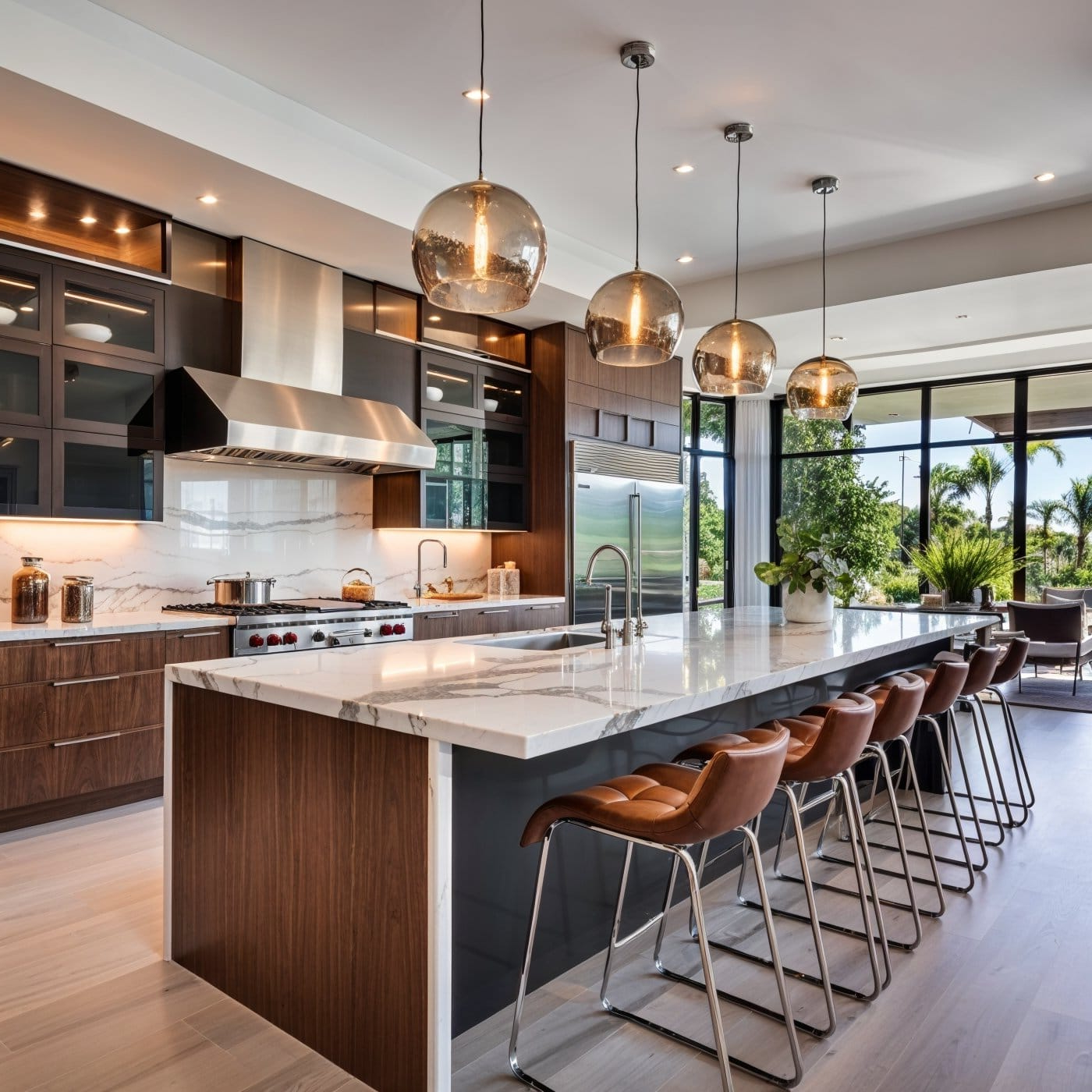
The L-Shape with Island (The Social Hub)
What: Cabinets on two perpendicular walls with a central unit.
Why: It eliminates the bottleneck. The island acts as a “Secondary Prep Zone,” allowing one person to cook while another preps or cleans.
The Island Rule: The island must be at least 4 feet long and 2 feet deep to be scientifically useful as a prep station.
-
The U-Shape (The Efficiency Cocoon)
What: Three walls of cabinetry.
Why: It provides the most storage per square foot.
The Trap: Dead corners. Use “Magic Corners” or “LeMans” pull-outs to ensure the space isn’t wasted.
The Psychology of the Workspace
Why do some kitchens feel “peaceful” while others feel “chaotic”?
Cognitive Friction
Cognitive friction occurs when you have to think about where a tool is. If your brain has to process “Where is the colander?” every time you boil pasta, you are depleting your daily “decision budget.”
The Solution: Point-of-Use Storage. Store the colander next to the sink. Store the spices next to the stove. It sounds simple, but 70% of home kitchens fail this basic test of logic.
Territorial Stress
In a multi-cook household, “territorial stress” arises when zones overlap.
The Solution: The “Double Sink” Strategy. Adding a small “bar sink” in the prep island allows one person to wash vegetables while the other cleans pots in the main sink. This 5-square-foot addition can reduce household arguments by 50%.
Specific Solutions for Common Problems
Problem: The “One-Wall” Kitchen in a Small Apartment
Scientific Solution: Use verticality. Install cabinets that go all the way to the ceiling. Use a “mobile island” (a cart on locking casters) that can be moved into the center of the room for prep and pushed against a wall for dining.
Cost: $800 – $2,500 for high-quality mobile units.
Problem: The “Corner Dead Zone”
Scientific Solution: Blind corners are the “black holes” of kitchen design.
Hardware Solution: Install a Cloud Pull-out or a Lazy Susan.
Cost: $400 – $900 per unit.
Problem: Dim, Shadow-Laden Prep Areas
Scientific Solution: Under-cabinet LED tape lighting.
Why: Overhead lights create a shadow of your own body over the food you are cutting. Under-cabinet lighting places the light between your eyes and the knife.
Cost: $200 – $600 for a DIY or pro-install kit.
Conclusion: The ROI of Good Science
Investing in the science of kitchen workflow provides two types of “Returns on Investment.”
- Financial ROI: A well-planned kitchen typically recoups 60–80% of its cost upon home sale.
- Biological ROI: This is the unquantifiable benefit of lower stress, fewer backaches, and more joy in the act of creation.
Effective kitchen planning isn’t about the color of your cabinets or the brand of your range; it is about the grace of movement. It is about creating a space where the transition from hunger to satisfaction is as seamless and ergonomic as possible.
Final Recommendations: Designing a Kitchen That Truly Works for Real Life
A kitchen renovation is often framed as a visual upgrade—new cabinets, trendy finishes, stylish lighting. But anyone who actually cooks, cleans, hosts, or simply lives in their home knows this truth: a kitchen succeeds or fails based on how it supports daily behavior, not how it photographs.
The most expensive kitchen in the world can still feel exhausting if the layout fights you. Meanwhile, a modest kitchen can feel luxurious if it anticipates your movements, reduces friction, and respects how your body and habits actually work.
The following recommendations are not about trends. They are about function, longevity, and lived experience—the kind of insights that prevent regret years after the renovation dust has settled.
-
Audit Before You Act: Observe Yourself Before You Redesign Anything
Before you move walls, order cabinets, or fall in love with a Pinterest layout, do one deceptively simple thing: watch yourself use your current kitchen.
Not casually. Not based on memory. Actually observe it.
Why Memory Lies About Kitchen Problems
Most homeowners redesign their kitchen based on vague frustrations:
- “It feels cramped.”
- “I’m always walking back and forth.”
- “Something about it just doesn’t work.”
The problem is that memory smooths over details. You remember being annoyed—but not why, where, or how often. Those details matter enormously when designing a functional layout.
A one-week audit removes guesswork.
How to Do a Practical Kitchen Audit
Set up a phone or camera to record a time-lapse during meal prep—breakfast, lunch, or dinner. You don’t need audio. You’re not filming for style. You’re capturing movement patterns.
Over the course of a week, you’ll start noticing:
- How often you walk between the sink and stove
- Whether you repeatedly open the same cabinet or drawer
- How frequently you backtrack because you forgot an item
- Where congestion happens when more than one person is present
- Which surfaces become clutter magnets
This is gold.
What to Look For Specifically
Backtracking Patterns
If you find yourself walking from the fridge to the counter, then back to the fridge, then to a drawer across the room—your layout is wasting energy. These inefficiencies add up fast, especially if you cook daily.
Search Friction
Pay attention to moments where you pause, open multiple cabinets, or shuffle items around to find something. That’s a storage logic problem—not a space problem.
Collision Zones
If two people can’t pass comfortably, or if an open dishwasher blocks a major pathway, you’ve identified a layout conflict that no cabinet finish will fix.
Emotional Friction
Notice moments of visible frustration—hesitation, sighs, abrupt movements. Design should reduce stress, not contribute to it.
Why This Audit Changes Everything
Once you’ve seen your own behavior objectively, design decisions stop being abstract. You no longer ask, “Does this look good?”
You ask, “Will this stop me from doing that thing I hate every day?”
That shift alone saves thousands of dollars in bad decisions.
-
Prioritize the “Big Three”: Sink, Fridge, and Lighting
When budgets tighten—as they often do—homeowners make the mistake of spreading money thinly across everything. The result? Nothing feels particularly good.
A smarter strategy is to prioritize the elements you interact with most frequently.
In nearly every kitchen, those are:
- The Sink
- The Refrigerator
- The Lighting
These three define how the kitchen feels every single day.
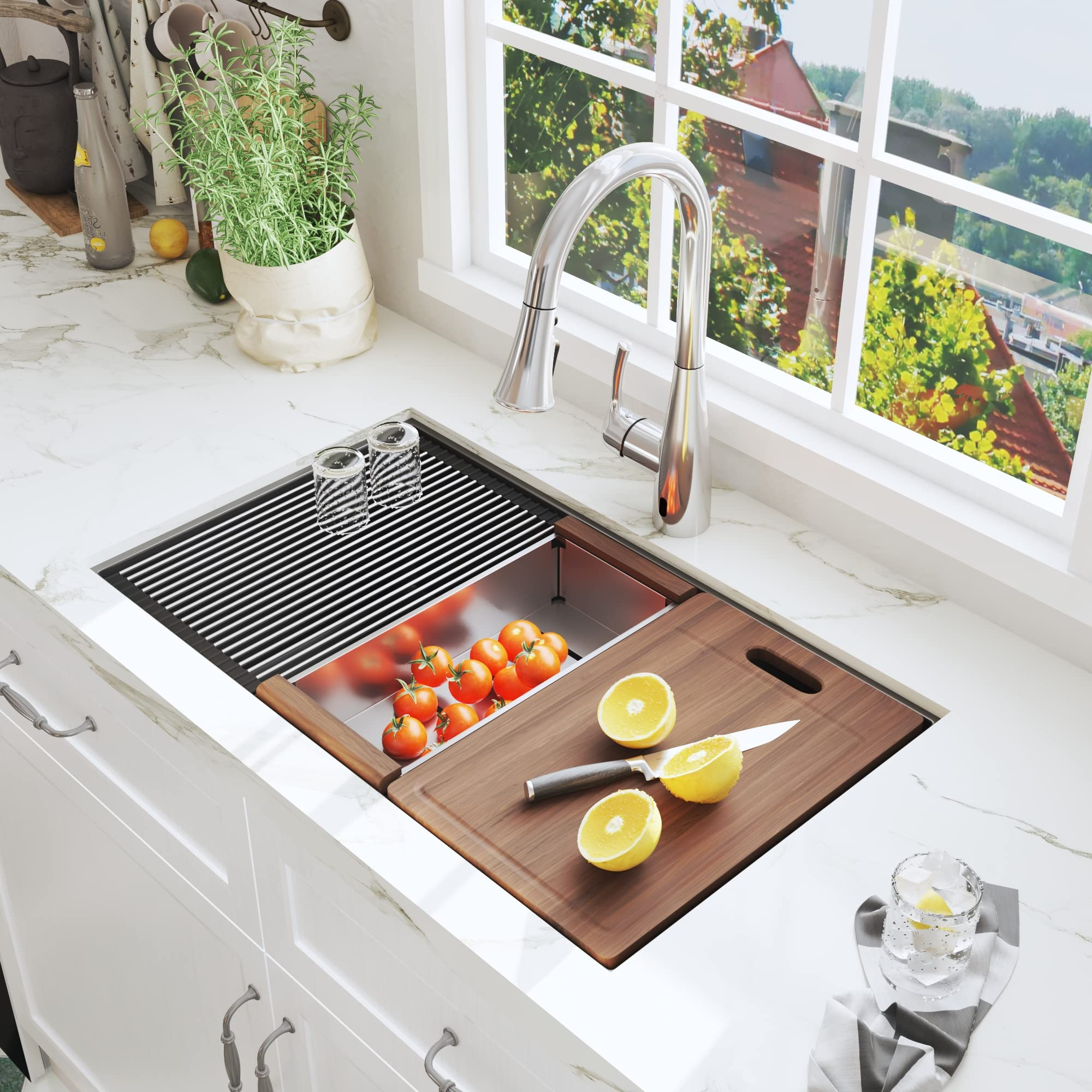
The Sink: The Unsung Epicenter of Kitchen Life
Most people underestimate the sink because it doesn’t feel glamorous. That’s a mistake.
You interact with the sink more than any other feature—washing hands, rinsing produce, filling pots, cleaning dishes, wiping counters. If the sink area is poorly designed, frustration is constant and unavoidable.
Depth and Bowl Configuration
A shallow sink leads to splashing and clutter. A deep sink contains mess and reduces cleanup time. Single-bowl sinks offer flexibility for large cookware, while double bowls help with multitasking—but only if both bowls are generously sized.
Faucet Ergonomics
A high-arc faucet with a pull-down spray isn’t a luxury; it’s a functional upgrade that reduces strain and speeds up tasks. Touchless or touch-activated faucets can also improve hygiene and efficiency—especially when hands are messy.
Sink Placement Matters
Placing the sink with no landing space on either side forces clutter. Ideally, there should be clear counter space for dirty dishes on one side and clean prep on the other.
The Sink Is a Workflow Anchor
In a well-designed kitchen, the sink connects logically to trash, dishwasher, prep space, and cooking zones. When this relationship is off, everything feels harder than it should.
The Refrigerator: Reduce Steps, Reduce Stress
The refrigerator isn’t just storage—it’s a traffic hub.
Every meal begins here. Poor fridge placement creates unnecessary walking, congestion, and inefficiency.
Door Swing Awareness
A fridge door that opens into a wall or blocks a major walkway is a daily irritation. The hinge direction and clearance space matter more than most people realize.
Distance from Prep Area
If the fridge is far from where you chop and assemble food, you’ll make extra trips without noticing—until fatigue sets in over time.
Interior Organization > Exterior Finish
Built-in looks nice, but interior flexibility matters more. Adjustable shelving, clear drawers, and logical zones make daily use smoother and reduce food waste.
Secondary Refrigeration
In busy households, a secondary fridge drawer or beverage fridge can drastically reduce traffic and improve flow—often more impactful than upgrading cabinet finishes.
Lighting: The Fastest Way to Improve Daily Experience
Lighting is often treated as decoration. In reality, it’s infrastructure.
A kitchen with poor lighting feels smaller, messier, and more stressful—even if everything else is done right.
Layered Lighting Is Non-Negotiable
- Ambient Lighting: General illumination for the whole room
- Task Lighting: Focused light over prep surfaces, sink, and stove
- Accent Lighting: Under-cabinet or toe-kick lighting for depth and mood
Relying on one ceiling fixture is a guaranteed failure.
Color Temperature Matters
Too warm, and food looks dull. Too cool, and the space feels clinical. Neutral white lighting (around 3000–4000K) strikes the right balance for most kitchens.
Shadow Control
Overhead lights alone cast shadows exactly where your hands work. Under-cabinet lighting eliminates this problem instantly.
If you can only upgrade one thing during a renovation, fix the lighting. The return on comfort is immediate.
-
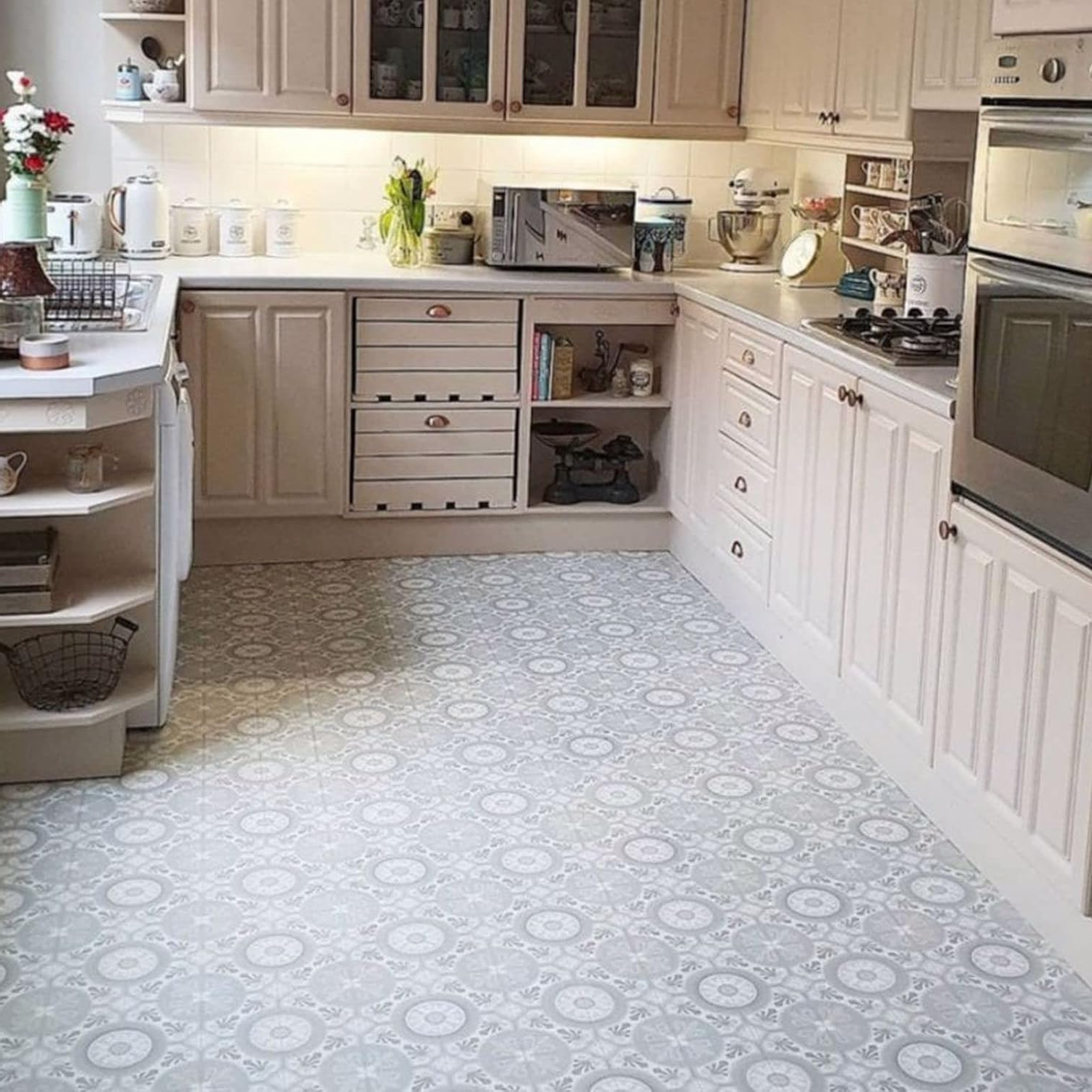
Don’t Ignore the Floor: Your Body Pays the Price
Floors are usually chosen last—after cabinets, counters, and appliances. That’s backward.
You interact with the kitchen floor with your entire body, often for long periods. The wrong choice leads to fatigue, joint pain, and long-term discomfort.
The Hidden Cost of “Beautiful but Brutal” Floors
Stone, porcelain, and concrete floors look stunning. They also have zero forgiveness.
Standing on hard surfaces for extended periods compresses joints and muscles. Over time, this leads to:
- Foot pain
- Knee discomfort
- Lower back strain
- General fatigue
You might not notice it immediately—but your body does.
Flooring with “Give” Changes Everything
Materials like high-quality vinyl, cork, engineered wood, or wood-look composites provide subtle elasticity. That small amount of flex reduces impact and increases comfort dramatically.
The difference is especially noticeable if you:
- Cook frequently
- Prep meals from scratch
- Spend time baking or hosting
- Stand at the sink for long stretches
Maintenance vs. Comfort Trade-Offs
Some homeowners choose stone for durability and resale value. That’s valid—but comfort should factor into the equation.
A compromise approach includes:
- Softer flooring in primary prep zones
- Anti-fatigue mats integrated into the design
- Area rugs with low-profile padding
Design is not just visual—it’s physical.
-
Hire a Designer for Layout, Not Just Style
Many homeowners assume a kitchen designer is there to pick finishes and colors. In reality, the most valuable designers focus on layout, ergonomics, and standards.
A certified kitchen designer (CKD) understands rules that most contractors do not.
Why NKBA Standards Matter
The National Kitchen & Bath Association (NKBA) guidelines are based on decades of research into human movement, safety, and efficiency.
These include:
- Minimum aisle widths
- Clearance for appliances and doors
- Safe distances between work zones
- Ergonomic counter heights
- Proper landing space requirements
Contractors may know how to build—but they don’t always know why certain dimensions exist.
Style Is Easy. Flow Is Hard.
Anyone can choose cabinet colors. Very few people can anticipate how a space will feel during:
- A rushed weekday breakfast
- Two people cooking simultaneously
- Hosting guests while prepping food
- Cleaning up after a large meal
Designers trained in layout think in scenarios—not aesthetics alone.
The Cost of Skipping Professional Layout Help
Most kitchen regrets are structural:
- “I wish the island were smaller.”
- “The dishwasher blocks the walkway.”
- “I didn’t realize how tight this would feel.”
- “I hate how far the trash is from the sink.”
These are layout mistakes. And they’re expensive to fix later.
Hiring a designer just for layout—even if you choose finishes yourself—is often the best return on investment in the entire project.
The Bigger Picture: Design for the Life You Actually Live
The most successful kitchens are not the most photographed ones. They are the kitchens where:
- Movement feels natural
- Tasks flow logically
- The body feels supported
- Stress is reduced, not amplified
A well-designed kitchen disappears into daily life. You stop noticing it—because it works.
If you remember nothing else, remember this:
Good kitchen design doesn’t impress guests. It supports you. Every day.
That’s the goal worth designing for.